Terrestrial phenology and stream metabolism
A look at the timing of river metabolism with respect to terrestrial phenology

Phenology includes a number of recurring life-history events such as the flowering of plants, the timing of bird migrations, and when fish begin spawning. Phenology is the rhythm of the natural world and results from the interaction between biology and environmental conditions. We experience these events as part of our daily lives and amateur and professional naturalists have observed and recorded phenology for hundreds of years.
“Phenology is the study of the timing of recurrent biological events, the causes of their timing with regard to biotic and abiotic forces, and the interrelation among phases of the same or different species. -- Lieth (1974)”
Lieth, H. (1974). Phenology and seasonality modeling (H. Lieth Ed.). New York: Springer.
The seasonality of the plants, animals, and insects around us are an important part of our lives. Timing matters whether it is when flowers emerge for pollinators or when plants on the forest floor have time to grow before trees blanket them in shade for the summer. Windows of favorable temperature, moisture, light, and other conditions influence when primary producers thrive. Across an ecosystem the timing of these phenological events is often intertwined as annual cycles of growth, movement, or reproduction interact to create the patterns we observe. Notably, many phenological events are related to temperature and long term phenological records serve as an independent measure of changing climate.
There isn’t a one size fits all approach to observing phenology. Traditionally phenology observation might involve things like noting the timing of plant bud burst or fish spawning. These records were collected by horticulturalists, scientists, naturalists, and amateur observers. This legacy is continued today at such places as The USA national phenology network. With the advent of new sensor technologies the definition of phenology has expanded to include more continuous observation of seasonality. For example, the use of satellites or fixed cameras to monitor land surface phenology.
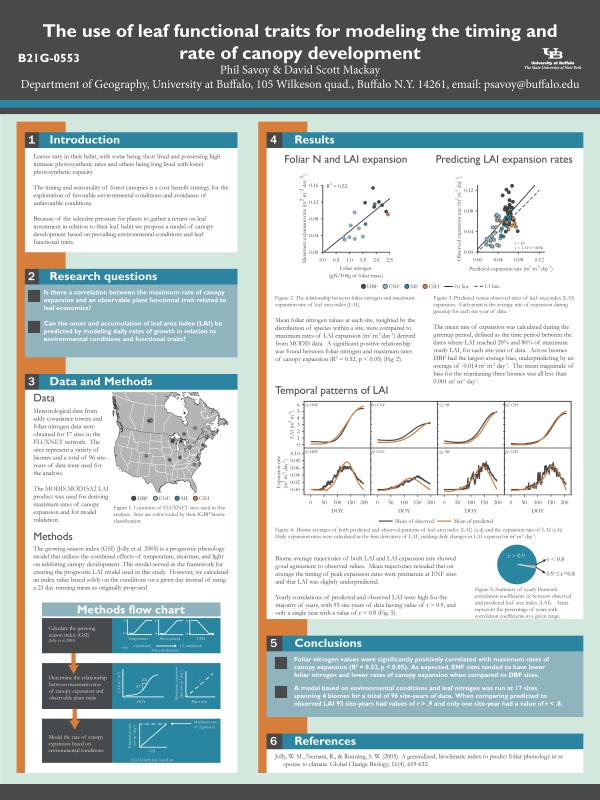
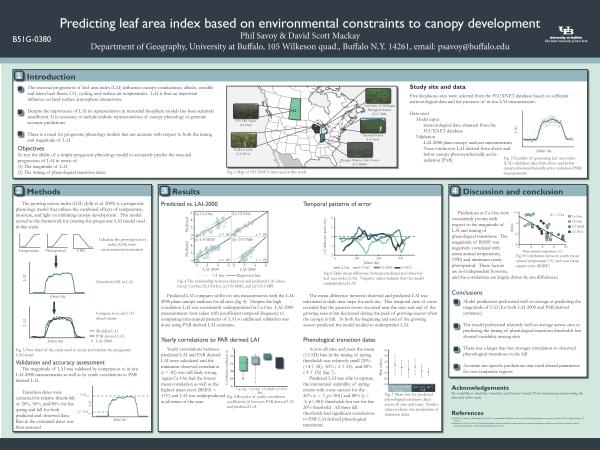
Because I usually work with time series of ecological data, much of my work is phenological in nature. I have worked in forests where I designed models that included more representation of plant physiology to predict seasonal patterns of leaf development. Including these processes it is possible to more accurately reproduce how plant biology and environmental conditions interact on the landscape.
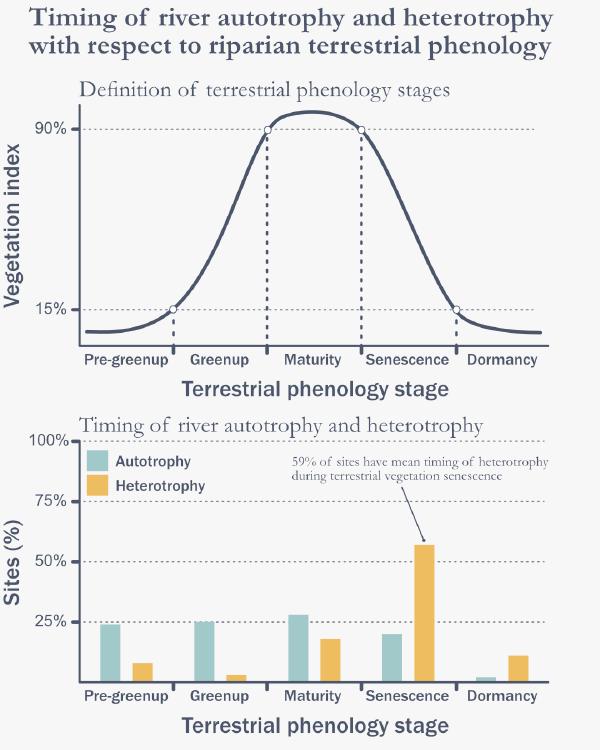
I have also worked extensively in rivers where I looked at ecosystem phenology through the lense of ecosystem metabolism. This approach is less focused on individual organisms and instead looks at the seasonality of energy and gas cycling across an environment.
Savoy, P., Appling, A. P., Heffernan, J. B., Stets, E. G., Read, J. S., Harvey J. W., & Bernhardt, E. S. (2019). Metabolic rhythms in flowing waters: An approach for classifying river productivity regimes. Limnology and Oceanography, 64(5), 1835–1851. https://doi.org/10.1002/lno.11154
Savoy, P., & Mackay, D. S. (2015). Modeling the seasonal dynamics of leaf area index based on environmental constraints to canopy development. Agricultural and Forest Meteorology, 200, 46–56. https://doi.org/10.1016/j.agrformet.2014.09.019