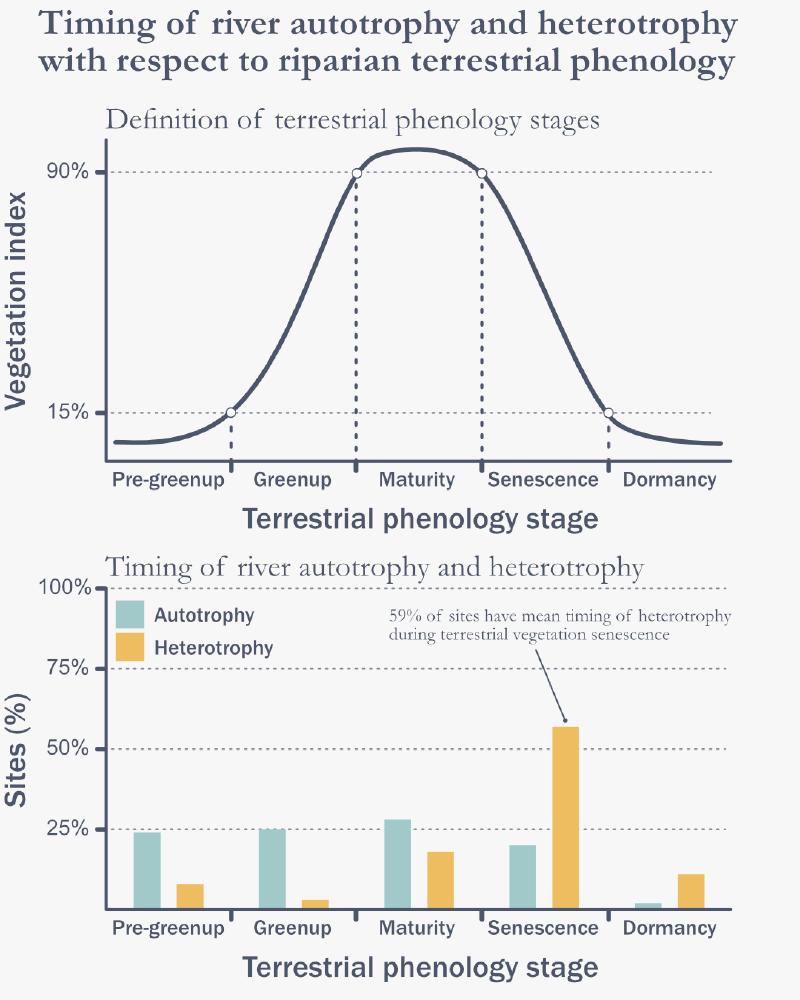
Previously I explored the timing of river autotrophy and heterotrophy by calculating the mean timing of each for a few hundred rivers. Autotrophy more commonly occurred in spring and summer whereas heterotrophy more commonly occurred in summer and autumn. Since terrestrial systems can serve as sources of organic matter inputs to rivers, I wanted to look at the patterns of river metabolism in relation to changes in terrestrial vegetation phenology.
I used MODIS vegetation dynamics data to get stages of terrestrial phenological development at each site (e.g. greenup or senescence) and determined which stage of development autotrophy and heterotrophy occurred in.
Autotrophy was relatively evenly distributed throughout phenological stages, with about 25% of sites falling into each stage outside of dormancy. By contrast, 59% of sites had their mean timing of heterotrophy occur during senescence. The prevalence of heterotrophy during senescence of terrestrial vegetation could be due to inputs of organic matter in the form of leaf litterfall.
If this topic interests you, Bertuzzo et al. (2022) has a modeling study that looks into different sources of organic matter and river ecosystem respiration rates.