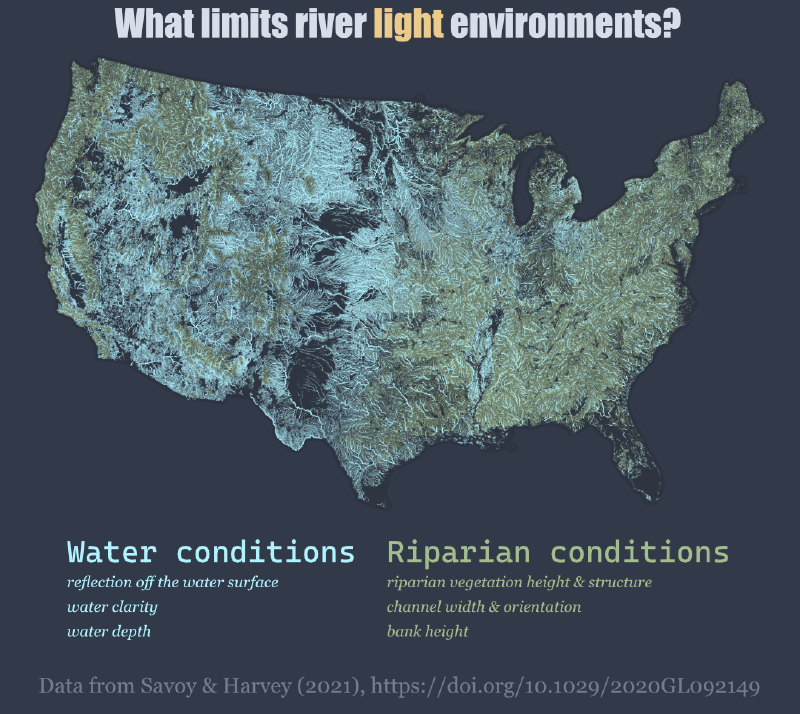
The conversion of solar energy to chemical energy by primary producers is a fundamental piece of carbon cycling and energy flow within ecosystems, but river autotrophs often only receive a small fraction of incoming sunlight. Lighting conditions within rivers are influenced by many factors including the size and shape of the river itself, surrounding riparian zones, and changing water conditions.
A few years ago, I designed a model predict light available for river primary producers and used the model to infer whether productivity was most limited by riparian zones or water column processes for over 2 million reaches in the US. We found that water column processes most limited productivity for 50% of the nation’s river length and 80% of its surface area. At the time we found some variations across the country that appeared to be driven by forest cover, but I thought it would be interesting to visualize predictions using national hydrography flowlines. This was a fun exercise to revisit some old work and look at it in a new way.
If you are interested in learning more about this model or our results, you can find our paper here https://doi.org/10.1029/2020GL092149